

extinction
66 ma
the end of an era
section titled “the end of an era”approximately 66 million years ago, the history of the earth changed radically.
the cretaceous came to an end and, with it, the long dominance of non-avian dinosaurs also ended.
it was not a slow change.
it was not a gradual transition.
it was a global crisis, rapid in geological terms and devastating for much of the planet’s life.
an impact that changed the world
section titled “an impact that changed the world”the most accepted hypothesis today explains this extinction from the impact of a large asteroid.
this object hit the earth in the region that today corresponds to the yucatan peninsula, in present-day mexico.
the impact site left as a trace the chicxulub crater.
the energy released was immense.
much greater than any isolated volcanic eruption or any phenomenon that humanity has faced.
the impact triggered a chain of consequences that affected the entire planet.
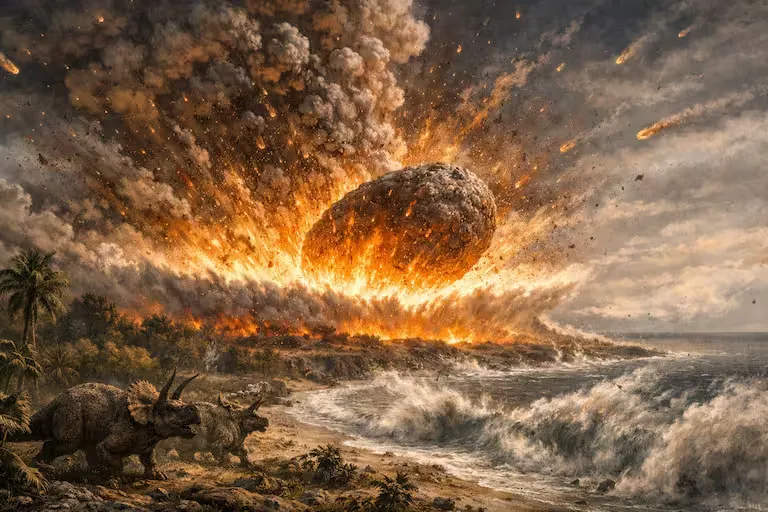
> representation of the impact that marked the end of the cretaceous
the first consequences
section titled “the first consequences”the collision not only destroyed the impact area.
its effects spread throughout the planet.
among the most immediate consequences were:
- a gigantic shock wave
- earthquakes of enormous magnitude
- large-scale fires
- tsunamis that traveled entire oceans
- massive ejection of dust, ashes and materials into the atmosphere
for a time, the earth must have seemed unrecognizable.
what until then was a world full of complex ecosystems became a wounded planet covered in destruction.
a covered sky
section titled “a covered sky”one of the most serious effects was not the initial impact itself, but what happened afterwards.
the enormous amount of dust and materials ejected into the atmosphere blocked part of the sunlight.
this drastically reduced the energy that reached the surface.
without enough light:
- photosynthesis stopped or fell extremely
- plants began to die
- many food chains collapsed
- ecosystems lost stability
the problem was no longer just local.
it was planetary.
the collapse of complex life
section titled “the collapse of complex life”when the base of trophic chains collapses, everything else starts to fall behind.
large herbivores depend on plants.
large predators depend on herbivores.
and entire ecosystems depend on very delicate balances.
that explains why so many groups disappeared at the same time.
the crisis did not affect only dinosaurs.
many marine organisms, reptiles, plants and many other living beings also disappeared.
it is estimated that the extinction at the end of the cretaceous eliminated a large part of the planet’s species.
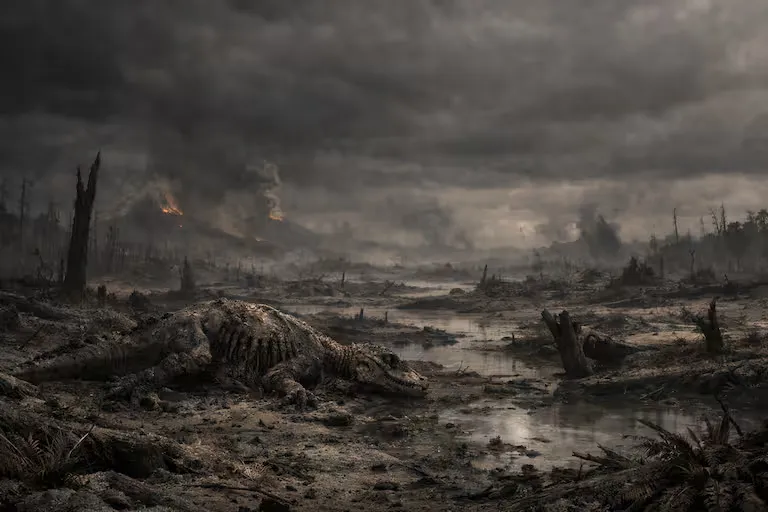
> atmospheric dust and ecological collapse transformed the planet during the crisis
why non-avian dinosaurs disappeared
section titled “why non-avian dinosaurs disappeared”dinosaurs had dominated the earth for millions and millions of years.
they had survived climatic changes, continental movements and ecosystem transformations.
but the crisis at the end of the cretaceous was different.
many of the large non-avian dinosaurs depended on complex ecosystems and relatively stable food chains.
when those networks collapsed, they could not adapt quickly enough.
large animals usually need:
- more food
- wide territories
- stable ecosystems
precisely what the planet stopped offering at that moment.
an extinction that was not total
section titled “an extinction that was not total”although we usually talk about “the extinction of the dinosaurs”, the reality is more precise.
not all disappeared
birds, direct descendants of theropod dinosaurs, survived.
this means that a part of the dinosaur lineage managed to cross the crisis and continue its history.
other groups also survived, among them small mammals, some reptiles, amphibians and various aquatic organisms.
the extinction was enormous, but not absolute.
and precisely from those survivors would emerge the next great chapter of life on earth.
the end of the mesozoic
section titled “the end of the mesozoic”the extinction 66 million years ago was not just the end of the cretaceous.
it was also the end of the entire mesozoic.
with it ended the world that had been dominated by dinosaurs, large marine reptiles and pterosaurs.
the earth entered a new stage.
ecosystems would have to reorganize again.
the empty niches would leave space for new groups.
history did not stop.
but it changed completely.
why this event was so important
section titled “why this event was so important”the extinction at the end of the cretaceous was one of the great inflection points in the planet’s history.
without it:
- non-avian dinosaurs might have continued to dominate the earth
- mammals probably would not have occupied so many niches
- the later world would have been very different
this event not only ended an era.
it also opened the door to the next one.
what came after
section titled “what came after”after the extinction a new stage began in the earth’s history.
ecosystems rebuilt themselves. mammals expanded. birds continued to evolve. the planet took a completely different direction.