

cenozoic
66 ma → present
a new era
section titled “a new era”the cenozoic began approximately 66 million years ago, right after the extinction that ended the cretaceous and the dominance of non-avian dinosaurs.
the earth was coming out of a global crisis.
many ecosystems had collapsed. many groups had disappeared. the balance of the mesozoic world had been broken.
but the history of life did not end.
as had happened other times, the planet began a new stage of recovery and transformation.
the world after the dinosaurs
section titled “the world after the dinosaurs”during the mesozoic, dinosaurs had dominated much of the terrestrial ecosystems.
after their disappearance, numerous ecological niches remained empty.
that allowed other groups, until then less visible, to begin to expand.
among them mammals stood out especially.
mammals had already existed for a long time, but during the mesozoic they had lived in the background.
in the cenozoic, that situation changed radically.
the expansion of mammals
section titled “the expansion of mammals”throughout the cenozoic, mammals diversified extraordinarily.
over millions of years appeared:
- large herbivores
- terrestrial predators
- arboreal forms
- marine mammals
- animals adapted to open plains
- increasingly specialized lineages
this expansion was not immediate, but deep.
the cenozoic was the era in which mammals came to occupy many of the great ecological niches of the planet.
birds, continents and changing climates
section titled “birds, continents and changing climates”mammals were not the only protagonists.
birds, direct descendants of theropod dinosaurs, continued to evolve and adapt to new environments.
at the same time, continents continued to move and adopt increasingly recognizable positions.
this deeply altered:
- the global climate
- ocean currents
- the distribution of life
- the formation of regional ecosystems
the cenozoic was a long and changing era, not a uniform block.
three great stages
section titled “three great stages”to understand the cenozoic well it is convenient to divide it into three great periods.
paleogene
section titled “paleogene”the paleogene was the reconstruction stage after the extinction.
life reorganized and many groups began to expand in a world that was still recovering from the crisis at the end of the cretaceous.
neogene
section titled “neogene”the neogene was a stage of transformation towards increasingly modern ecosystems.
open landscapes extended, climates changed and many mammals acquired forms that are already more familiar to us.
quaternary
section titled “quaternary”the quaternary is the most recent stage.
in it developed the great glaciations, the megafauna and, much later, the appearance and expansion of humans.
a world increasingly modern
section titled “a world increasingly modern”as this era progressed, the earth acquired traits increasingly close to the current ones.
- continents approached their modern positions
- more recognizable ecosystems emerged
- birds and mammals continued to diversify
- the climate changed several times
- the lineages that would lead to our own species appeared
this makes the cenozoic not just the stage after the dinosaurs.
it is also the era in which the world we know began to form.
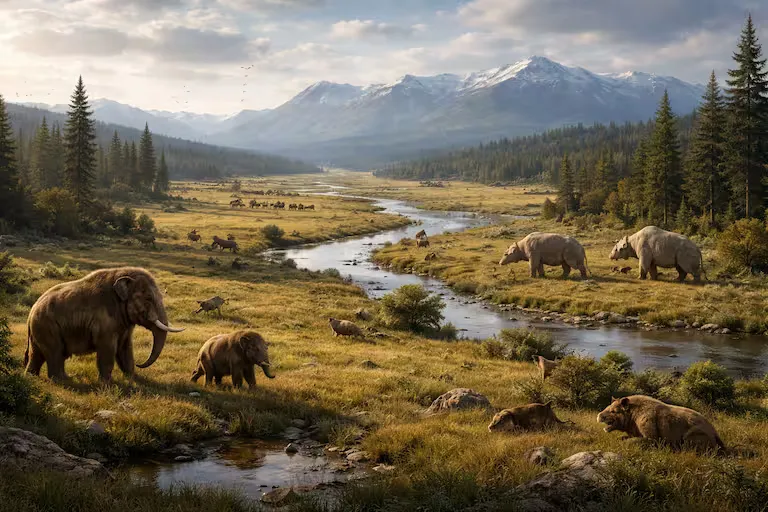
> cenozoic landscape
a history that remains open
section titled “a history that remains open”unlike other great geological stages, the cenozoic has not ended.
we still live within this era.
that means that the present is part of the same great chapter that began after the extinction at the end of the cretaceous.
the history begun after the fall of the mesozoic world continues to develop.
what comes now
section titled “what comes now”to understand this era well, it must be traversed step by step.
first, the paleogene, when life began to rebuild after the great extinction.