

paleozoic
541 ma → 252 ma
a decisive era
section titled “a decisive era”the paleozoic was one of the great eras of the history of life.
it began approximately 541 million years ago and ended 252 million years ago.
during this immense interval, life changed scale.
the oceans filled with complex organisms. many of the great animal groups appeared. the first vertebrates emerged. life began to occupy dry land.
it was an era of innovation, expansion and deep transformation.
an explosion of diversity
section titled “an explosion of diversity”the paleozoic begins with one of the most important episodes in all biological history:
the cambrian explosion
in a relatively short interval, from the geological point of view, an enormous diversity of animal forms appeared.
many organisms developed new structures:
- shells
- external skeletons
- specialized appendages
- more complex sensory organs
the seas stopped being dominated only by simple forms.
they became active, varied and competitive ecosystems.
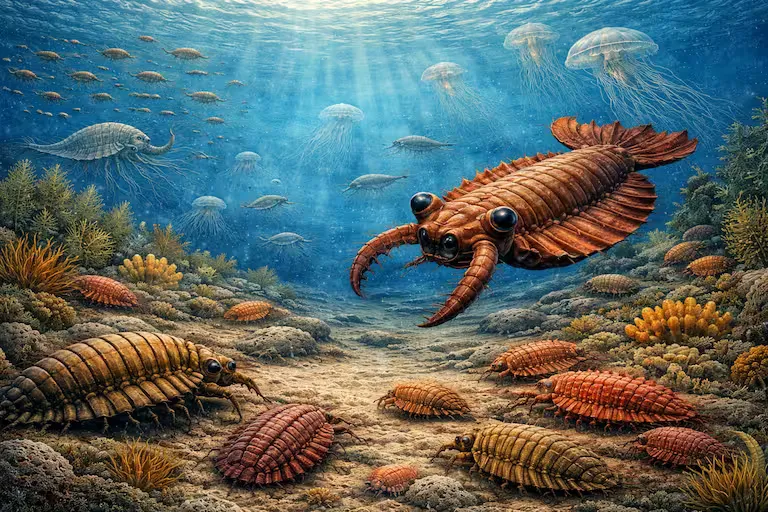
> recreation of the organisms that emerged after the cambrian explosion
the first great marine ecosystems
section titled “the first great marine ecosystems”during much of the paleozoic, life developed mainly in the oceans.
there thrived numerous organisms that today are emblematic of this era.
among them were:
- trilobites
- anomalocaris and other early large predators
- brachiopods
- mollusks
- primitive corals
- different types of marine arthropods
these ecosystems were not simple.
there was predation, competition, defense and continuous adaptation.
the paleozoic was the time when complex animal life unfolded strongly in the sea.
the first vertebrates
section titled “the first vertebrates”another of the great milestones of the paleozoic was the appearance and diversification of the first vertebrates.
at first very primitive fish emerged, many of them without jaws.
later more complex forms appeared, with anatomical improvements that would forever change the history of animals.
among the most important changes were:
- the development of jaws
- more efficient swimming
- greater predation capacity
- new survival strategies
these first vertebrates marked the beginning of a long evolutionary history that, millions of years later, would give rise to amphibians, reptiles, mammals and birds.
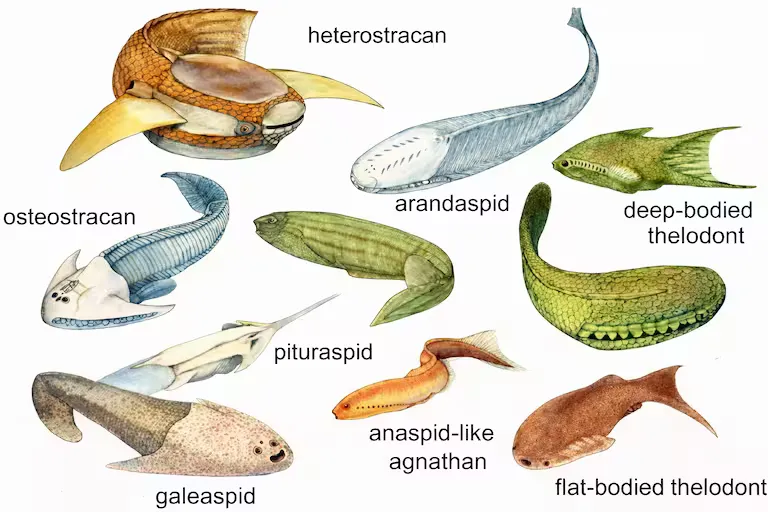
> first primitive fish in paleozoic oceans
life comes out of the water
section titled “life comes out of the water”one of the most transcendental changes of the paleozoic was the colonization of dry land.
for a long time, the continents had been almost empty spaces from the biological point of view.
that began to change little by little.
first primitive plants capable of surviving outside the water appeared.
then other organisms came that began to take advantage of that new world.
among the first great steps were:
- the expansion of the first terrestrial plants
- the appearance of arthropods and insects on land
- the evolution of amphibians from aquatic vertebrates
the terrestrial surface stopped being a naked space and began to become an increasingly complex biological scenario.
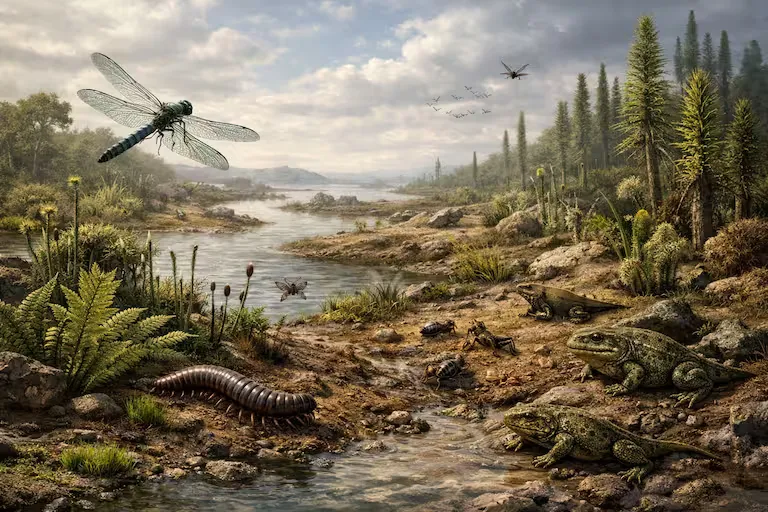
> first terrestrial ecosystems with plants and insects
forests, swamps and new animals
section titled “forests, swamps and new animals”as the paleozoic progressed, terrestrial life continued to expand.
large forests appeared, extensive swampy areas and increasingly rich ecosystems.
in that context new forms of life evolved:
- more complex plants
- large insects
- diverse amphibians
- the first reptiles
these changes were decisive because they allowed some vertebrates to stop depending completely on water for reproduction.
that opened the door to a much wider occupation of terrestrial environments.
the paleozoic not only filled the seas with life.
it also laid the foundations of continental ecosystems.
a very different earth
section titled “a very different earth”although the paleozoic was a fundamental stage for the development of complex life, the world of then was very different from the current one.
the continents had other positions. climates changed over millions of years. ecosystems were formed by organisms that, in many cases, no longer exist today.
however, many of the bases of later life were born here.
in this era processes that would be essential in the future were consolidated:
- more complex trophic networks
- large marine communities
- increasingly varied vertebrates
- expansion of terrestrial life
the paleozoic was one of the great evolutionary laboratories of the history of the earth
the end of an era
section titled “the end of an era”the paleozoic ended abruptly and devastatingly.
its closure was marked by the greatest known mass extinction:
the permian extinction
during this crisis an enormous proportion of the planet’s species disappeared.
the consequences were immense:
- entire ecosystems collapsed
- many lineages disappeared
- biodiversity fell drastically
- the planet entered a phase of deep reorganization
the end of the paleozoic was not just the closure of an era.
it was the collapse of an entire world.
why the paleozoic was so important
section titled “why the paleozoic was so important”the paleozoic was decisive because in it occurred some of the most fundamental changes in the entire history of life.
during this era:
- animal life diversified extraordinarily
- the first great complex marine ecosystems appeared
- the first vertebrates emerged
- life began to colonize dry land
- terrestrial plants, arthropods, amphibians and early reptiles evolved
- everything ended with a mass extinction that transformed the planet
if the precambrian had prepared the stage, the paleozoic was the era in which life began to unfold all its potential.
what comes after
section titled “what comes after”after the great extinction at the end of the permian, a new stage began.
the planet reorganized itself again. ecosystems changed again. new groups would begin to dominate the earth.
among them, the dinosaurs.
thus began the mesozoic.