

quaternary
2.58 ma → present
a world very close to ours
section titled “a world very close to ours”the quaternary is the most recent stage of the cenozoic.
it began approximately 2.58 million years ago and continues to the present.
if the neogene had brought the planet to a quite recognizable form, the quaternary is the stage in which the earth acquires a fully modern appearance.
the continents occupied positions very similar to the current ones. many ecosystems were already familiar. much of the fauna had forms close to modern ones.
but it was not a quiet stage.
the quaternary was marked by intense and repeated climatic changes.
the time of glaciations
section titled “the time of glaciations”one of the most important features of the quaternary was the alternation between cold periods and warmer periods.
during cold phases, large ice masses expanded over wide regions of the planet.
during warmer phases, those ices retreated.
these cycles deeply affected life and the landscape.
in this context:
- sea levels changed
- forests, grasslands and deserts moved
- many species had to migrate
- ecosystems reorganized again and again
the quaternary was a stage of constant climatic instability.
landscapes in continuous change
section titled “landscapes in continuous change”the quaternary landscapes did not remain fixed.
at some times, large areas were covered by ice. at others, cold steppes, grasslands or temperate forests dominated.
this made the distribution of life change many times throughout the period.
many animals had to adapt to the cold, to the seasonal scarcity of resources or to long displacements.
others disappeared when conditions stopped favoring them.
the quaternary was a modern stage, yes, but also hard and changing.
megafauna and large mammals
section titled “megafauna and large mammals”during much of the quaternary lived many large mammals that no longer exist today.
among them were:
- mammoths
- mastodons
- woolly rhinoceroses
- giant deer
- large ground sloths
- saber-toothed tigers and other predators
this megafauna was an essential part of numerous ecosystems.
many of these animals were adapted to cold or open environments, although not all lived in the same places or at the same time.
their disappearance, in many cases at the end of the pleistocene, deeply transformed the planet’s fauna.
the appearance of humans
section titled “the appearance of humans”the quaternary is especially important because during this stage the genus homo appeared and evolved.
much later than the first hominins of the neogene, different human species emerged.
among them was finally homo sapiens.
human history is part of the quaternary.
in this stage:
- increasingly complex tools appeared
- new forms of organization developed
- human groups expanded across different continents
- the relationship between a species and its environment acquired a new dimension
for the first time, a living being began to transform the planet in an increasingly deep and conscious way.
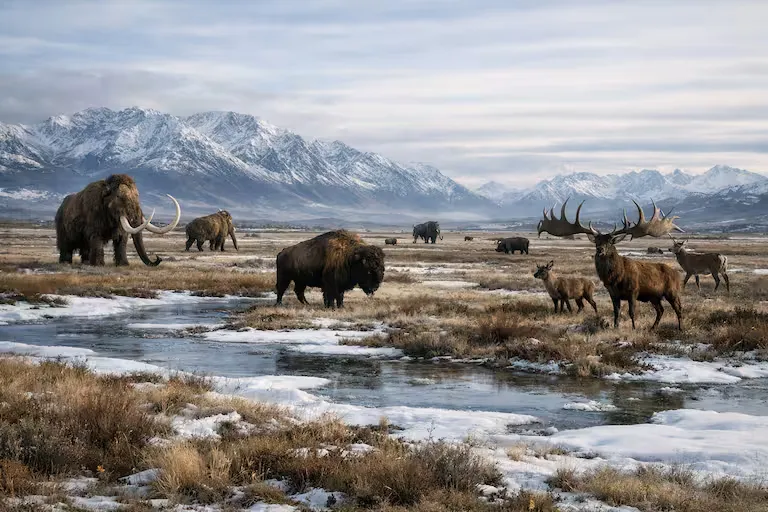
> quaternary landscape, a stage marked by changing climates, large mammals and human expansion
a period divided into two parts
section titled “a period divided into two parts”the quaternary is divided into two great epochs:
- pleistocene
- holocene
the pleistocene was the stage of the great glaciations and much of the best-known megafauna.
the holocene, more recent, began about 11,700 years ago, after the end of the last great glaciation.
it is the epoch in which we live today.
from pleistocene to holocene
section titled “from pleistocene to holocene”the transition from pleistocene to holocene involved an important change.
the climate became more stable and temperate than during the great glacial pulses before.
that favored the expansion of forests in many regions and created new conditions for human life.
it was in this context that processes such as:
- the development of agriculture
- the more permanent settlement of human populations
- the formation of increasingly complex societies
the world continued to change, but now it did so with an increasingly decisive human presence.
recent extinctions and transformations
section titled “recent extinctions and transformations”the quaternary was not only a stage of appearance.
it was also a stage of disappearances.
many large animals became extinct in different places on the planet at the end of the pleistocene and beginnings of the holocene.
the causes were not always unique.
in many cases they combine:
- climatic changes
- habitat transformation
- direct or indirect human pressure
this made the quaternary a key stage to understand how climate, ecosystems and human activity interact.
a fully modern planet
section titled “a fully modern planet”if we observe the quaternary as a whole, we see the consolidation of a world already completely modern in its geographical and ecological base.
the continents have their current form. the oceans follow recognizable patterns. the climates resemble ours. many plants and animals are close to the current ones.
however, the quaternary also shows that even a modern world can be deeply unstable.
the glaciations, migrations, extinctions and human action demonstrate it.
the quaternary is not only the most recent time of the earth, but also the scenario of our own history
why the quaternary was so important
section titled “why the quaternary was so important”the quaternary was decisive because it brings together many of the processes that explain the present world.
during this period:
- great glaciations succeeded each other
- ecosystems changed repeatedly
- large mammals lived that are extinct today
- humans appeared and expanded
- the human transformation of the planet began
- the environmental framework closest to the current one was configured