

triassic
252 ma → 201 ma
the beginning of the mesozoic
section titled “the beginning of the mesozoic”the triassic was the first period of the mesozoic.
it began approximately 252 million years ago and ended 201 million years ago.
it is a fundamental period because it marks the beginning of a new stage in the history of the earth, right after the permian mass extinction, the greatest biological catastrophe known.
when the triassic starts, the planet is not a place full of exuberant life.
it is a world trying to recover.
ecosystems have been deeply damaged, many species have disappeared and life has to reorganize almost from scratch.
that is why the triassic was a time of transition, reconstruction and change.
a wounded planet
section titled “a wounded planet”the extinction at the end of the permian had eliminated an immense part of marine and terrestrial life.
many dominant groups disappeared and ecosystems were weakened.
during the beginning of the triassic, the earth still dragged the consequences of that collapse:
- very reduced biodiversity
- simple and unstable ecosystems
- extreme climates in many regions
- little competition in some niches and too much pressure in others
this makes the early triassic not a particularly diverse world, but a hard planet, empty compared to later stages and still very marked by the previous crisis.
pangea dominated the world
section titled “pangea dominated the world”during the triassic, almost all the terrestrial masses of the planet were united in a single supercontinent: pangea.
this is one of the keys to understanding the period.
by having the earth organized in such a gigantic continental mass, the oceans were very far from the interior of many regions. that affected the climate enormously.
the result was a planet with large dry and extreme interior areas.
in many parts of the triassic world there were:
- immense deserts
- scarce rains
- very marked seasons
- strong thermal contrasts
the coast could be wetter, but the interior of pangea was, in many places, rough and hostile.
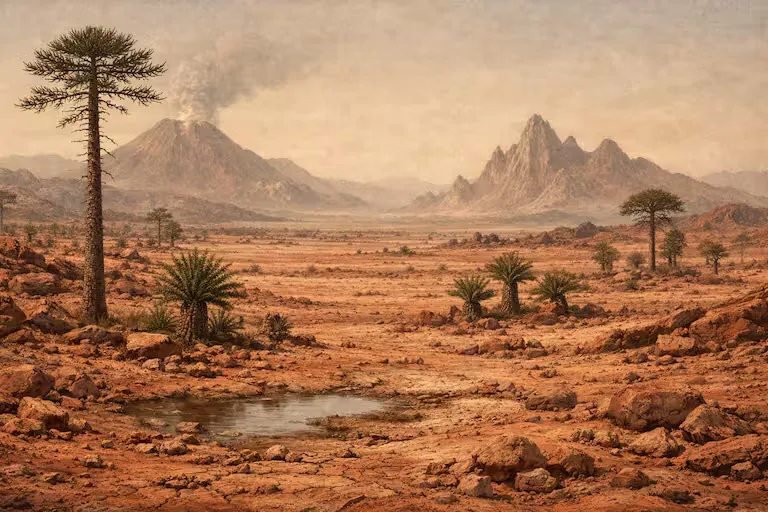
> arid triassic landscape, when pangea still dominated the terrestrial surface
a hard and changing climate
section titled “a hard and changing climate”the triassic is usually imagined as a uniformly dry stage, but reality was something more complex.
many regions were indeed arid for long periods, especially in the interior of pangea, although there were also areas with rivers, temporary lakes and somewhat wetter zones.
even so, as a whole, the triassic was a drier world than the later jurassic.
the combination of heat, water scarcity in many areas and large continental distances deeply conditioned life.
the animals that survived best were not necessarily the largest, but those that could adapt to a hard, variable and unstable environment.
a fauna in transition
section titled “a fauna in transition”in the triassic there is not yet that world clearly dominated by dinosaurs that we associate with the mesozoic.
the terrestrial fauna was a mixture of very different groups that competed to occupy the available niches.
among the most important animals were:
- primitive archosaurs
- large amphibians
- mammal-like reptiles
- predators that were not dinosaurs
- the first dinosaurs, still scarce at first
this makes the triassic a particularly interesting stage.
there is no absolute dominance of a single group. there is competition, evolutionary experimentation and many different lines trying to make their way.
it is a world in which the future is not yet decided.
archosaurs gain importance
section titled “archosaurs gain importance”one of the most important groups of the triassic was that of archosaurs.
from this great group would emerge later the dinosaurs, pterosaurs and crocodiles.
during the triassic, archosaurs were gaining relevance because they seemed especially well adapted to the dry and extreme environments of the time.
not all of them were dinosaurs, but many shared traits that gave them clear evolutionary advantages.
that is why, when we talk about the triassic, it is convenient to understand it as the time when archosaurs began to become protagonists of terrestrial life.
the first dinosaurs
section titled “the first dinosaurs”at some point in the middle and late triassic the first dinosaurs appeared.
at first they were not giants nor did they dominate ecosystems.
they were relatively small, slender and agile, and in many cases walked on two legs.
their appearance was very far from the classic image of the gigantic dinosaur.
some of these first dinosaurs probably looked more like fast and light runners than colossal monsters.
among their possible advantages were:
- a more efficient posture
- agile movements
- relatively light bodies
- ability to take advantage of different resources
for millions of years they coexisted with many other animals and did not yet occupy a dominant position.
that is important: in the triassic, dinosaurs appear, but they do not yet reign.
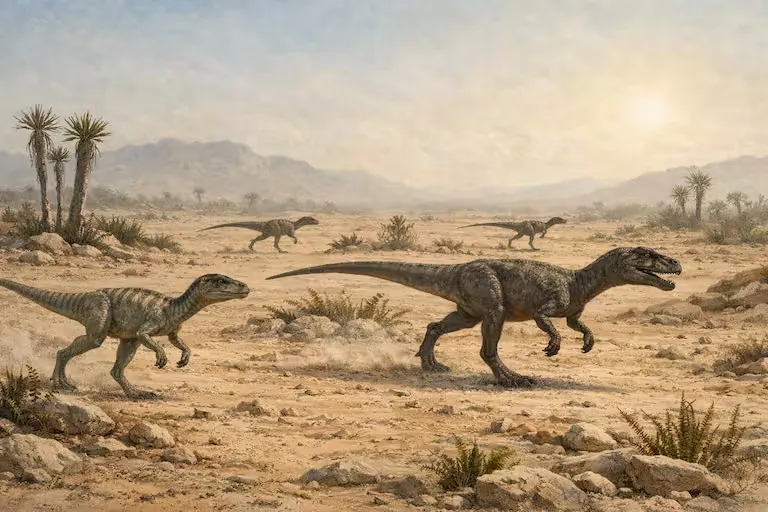
> representation of some of the first triassic dinosaurs
small, fast and still discreet
section titled “small, fast and still discreet”many of the first dinosaurs were animals of modest size.
they did not yet fill the great niches of giant herbivores or superpredators that would be seen later.
that would come much later.
in this initial stage, they seemed to be part of a broader fauna, without standing out yet above the rest.
precisely for that reason the triassic is so interesting from the evolutionary point of view.
it allows us to see dinosaurs before becoming the dominant group, when they were still a possibility and not a certainty.
the first mammals also appear
section titled “the first mammals also appear”the triassic is not only important for the history of dinosaurs.
it is also for the history of mammals.
from mammal-like reptiles and other related lineages, the first primitive mammals began to emerge.
they were small, discreet animals and probably with habits very different from the large reptiles that surrounded them.
during this stage they did not play a central role in ecosystems, but their appearance was crucial.
although they lived in the background, they already represented the beginning of an evolutionary line that much later would acquire enormous importance.
the sky and the sea were also changing
section titled “the sky and the sea were also changing”the triassic was not only a transformation on dry land.
during this period new groups also began to develop in other environments.
in the sky the first pterosaurs would emerge, while in the seas different marine reptiles diversified.
this means that the triassic was a stage of global reorganization.
life was not recovering only in a specific environment, but in all the great scenarios of the planet:
- dry land
- oceans
- air
a different vegetation
section titled “a different vegetation”the triassic flora was also very different from the current one.
flowering plants did not yet exist.
the plant landscape was dominated by groups such as:
- conifers
- ferns
- cycads
- ginkgos
in the most favorable regions, these plants formed landscapes that accompanied the slow recovery of ecosystems.
but in many other areas, aridity still limited plant diversity enormously.
the late triassic and the decisive change
section titled “the late triassic and the decisive change”towards the end of the triassic, many ecosystems had become more complex than at the beginning of the period.
life had had time to diversify, adapt and expand.
the dinosaurs, although not yet completely dominant in all environments, were already in a much stronger position than at the beginning.
and then another great change occurred.
the extinction at the end of the triassic
section titled “the extinction at the end of the triassic”at the end of the triassic there was a new mass extinction.
although it was not as devastating as that at the end of the permian, it did eliminate many groups that competed with the dinosaurs.
this radically changed the ecological balance.
several of their rivals disappeared and the way was opened for dinosaurs to expand with much more force.
that is one of the reasons why the triassic is so important:
- here dinosaurs appear
- here they survive and evolve
- and here they are prepared to dominate the following period
why the triassic was decisive
section titled “why the triassic was decisive”the triassic was not yet the great golden age of dinosaurs.
it was perhaps something more interesting:
the moment when everything started
in this period the bases of many of the changes that would define the rest of the mesozoic were laid.
- the earth recovered from a great catastrophe
- ecosystems reorganized
- archosaurs gained prominence
- the first dinosaurs appeared
- the first mammals also emerged
- the end of the period eliminated many competitors
without the triassic, the jurassic would never have been possible.
what comes after
section titled “what comes after”the triassic was a time of beginning, transition and preparation.
the next period, the jurassic, would be very different.
there dinosaurs would stop being an evolutionary promise to become the great dominators of the earth.